
Object Record
Images
Metadata
Artist |
Arturo Rivera |
Title |
Aire |
Date |
n.d. |
Medium |
Charcoal, conté, and acrylic |
Technique |
Mixed media |
Dimensions |
40" x 56 1/4" |
Description |
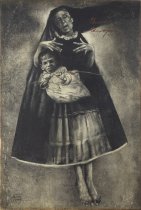
Arturo Rivera Aire, n.d. Charcoal, conté, and acrylic, 40" x 56 1/4" Mexic-Arte Museum Permanent Collection 2021.34.1.1 Gift of the artist Arturo Rivera’s drawing Aire makes a visual reference to La Llorona. The origin of La Llorona actually predates the arrival of the Spaniards. La Llorona is tied to both an Aztec Goddess and to one of the eight omens foretelling the invasion of Mexico. The motherly nature of La Llorona’s tragedy has also been compared to Cihuacóatl, an Aztec goddess who was considered a deity of motherhood. Her seeking of children to keep for herself is also significantly compared to that of Coatlicue, another significant mother figure. Coatlicue, (Serpent Skirt) Aztec earth goddess, is the symbol of the earth as both creator and destroyer, mother of the gods and mortals. The first texts that mention a woman with the characteristics of La Llorona? are located in the Florentine Codex, also known as Historia general de las cosas de Nueva España. The Florentine Codex is composed of twelve books, and was put together in 1577. Indigenous artists from Tlatelolco collected first-hand testimonies from native elders with the supervision of Fray Bernardino de Sahagún. The first and eighth books of the Florentine Codex indicate that the woman crying at night worried for her children, is none other than the goddess Cihuacóatl, whose name means "serpent woman". In chapter six of the first book, Sahagún narrates some apparitions by Cihuacóatl. He describes her attire as "white, with her hair as if she had horns crossed above her forehead." In book twelve of the Florentine Codex, native elders stated that ten years prior to the arrival of the Spaniards, the Mexica (Aztecs) and in particular Motecuhzoma (Moctezuma II), began to witness a series of omens. These prophecies signaled the arrival of men who waged war and the downfall of Tenochtitlan. Omen number six also describes a woman crying for her children as she roams the land, except she is crying for the future generations of the Aztecs as their people will eventually be conquered and destroyed. She cried out loudly at night, saying, "Oh my children, we are about to go forever." Sometimes she said, "Oh my children, where am I to take you?" The passage is accompanied by an illustration of the native woman, crying, barefooted, and clutching her hands. After the arrival of the Spaniards during colonial Mexico, the story of La Llorona evolved and other versions became part of the popular history. Some believe La Llorona was a native woman who had children with a Spaniard during colonial times and decided to drown them after he abandoned her. Others say that La Llorona is La Malinche who returns with remorse because of her "betrayal" towards indigenous people. In the United States, the story of La Llorona is told to scare children into good behavior, sometimes specifically to deter children from playing outside in the dark. Today’s popular version blames La Llorona for her own tears and exonerates others. It does not mention the foretold destruction of Tenochtitlan and arrival of the Europeans. It is important to understand that La Llorona is part of Mexico’s historical record. La Llorona and La Malinche are seen as iconic examples of the failed mother, that are passed down from generation to generation as simple myths. |
Object Name |
Mixed Media |
Search Terms |
La Llorona MX21 |
Object Number |
2021.34.1.1 |
Collection |
Mexic-Arte Museum Permanent Collection |