
Object Record
Images
Metadata
Artist |
Luis Jiménez |
Title |
Texas Waltz |
Date |
1985 |
Medium |
Color lithograph |
Dimensions |
H-56 W-39 inches |
Dimensions |
56" x 39" |
Description |
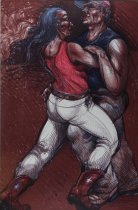
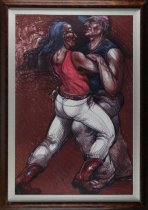
Luis Jiménez Texas Waltz, 1985 Color lithograph on paper, 56" x 39" Mexic-Arte Museum Collection 2020.2.156.28 Gift of Juan Antonio Sandoval Jr. Luis Jiménez created a series of artworks featuring dancers in honky tonks, dance halls, and fiestas. In the work, a mature looking couple dance the Texas Waltz, a contemporary style of the traditional waltz. The waltz originated in Europe in the 1700s, and was considered provocative as couples held each other closely as they danced. Here, a man waltzes with his partner, who embraces him tightly. The artist used energetic lines to denote action, and a bold red color in the woman’s top to indicate passion. The artist in other works depicted traditional Mexican dance, as in The Fiesta Jarabe sculpture, of which there exists five versions. His Fiesta sculpture represents the Mexican jarabe folk dance, often called the Mexican hat dance. One of his Fiesta Jarabe sculptures can be found at the Otay Mesa Port of Entry near San Diego, California. The sculpture was purchased by the U.S. federal government and erected in 1991. Describing the sculpture at Otay Mesa, Jiménez said, "It is a project that I thought of as a kind of bridge. I grew up on the border. I saw [immigrant] families crossing. My father was [an undocumented immgrant] from the time he was nine until I was born, when he was twenty-five. I decided that’s what I would focus on, and I’ll title it Fiesta, and people on both sides of the border will be able to relate to it." Proud of his Chicano roots, Luis Jiménez (1940-2006) was an El Paso, Texas native, best known for his large-scale, brightly colored sculptures immersed in the Chicano iconography of Texas and New Mexico. Jiménez studied art and architecture at The University of Texas in Austin and El Paso. He eventually traveled to Mexico to study the famous Mexican muralists Diego Rivera and José Clemente Orozco, and was also influenced by regionalists Thomas Hart Benton and Grant Wood. After completing school, he went to work for his father making neon signs and car decals. In 1966 Jiménez moved to New York and joined the Pop Art scene, making painted fiberglass figurative works inspired by the everyday lives of Latinos living in the Southwest. His work shows his concern for working-class people and those who have suffered from discrimination. Jimenez was and remains respected in Latino communities for his perspective and narrative of the culture of Mexico and the Southwest. His artwork emulates popular Cholo car culture, demonstrated in his use of fiberglass, spray paint, and imagery consisting of Aztec emperors, border crossing, and vaqueros riding wild broncos. His works are in the collections of the Albuquerque Museum, the Smithsonian American Art Museum in Washington, D.C., the El Paso Museum of Art, the Metropolitan Museum of Art in New York, the Art Institute of Chicago, and the Museum of Fine Arts in Houston, among others. |
Object Name |
|
Search Terms |
Border Dance Movement Luis Jimenez |
Object Number |
2020.2.156.28 |
Collection |
Juan Antonio Sandoval Jr. Collection |